Let Your Garden Be the Guide: Learning Your Site Conditions
Step 5 in How to choose the best native plants for your garden

If, like me, you’ve ever succumbed to nursery coup de foudre and brought home a gorgeous native plant that you couldn’t live without—only to watch it wither in your garden—you’re in good company!
It’s certainly a rite of passage and a learning experience to find out that simply because a plant is “native” does not mean that it will thrive in your specific location. It can be heartbreaking and discouraging, however, and can put you or others off of ecological gardening if you are just starting out. (Cue doubtful spouse or skeptical neighbor complaining, “why does the new native garden look so straggly?”) It does not have to be this way!
Welcome back to the fifth installment in our series on how to choose the best native plants for your garden. So far, we’ve explored why your ecoregion matters, how learning about natural plant communities can guide your palette, helpful ways to research plant nativity, and how the reality of nursery sourcing shapes your plant list.
Today, we’re zooming in closer to the level of your specific site. While it’s tempting to choose plants purely based on their aesthetics, ecological gardening asks us to observe and learn from our particular environmental conditions. It becomes more about balancing our aesthetic and management preferences with plants’ natural preferences, behavior, and functions within an ecosystem.


Think like a plant
Plants are more than decorative objects when we place them in our gardens. This is probably the biggest shift in concept when you move from conventional gardening to ecological gardening. Our culture has conditioned us to give primacy to our human tastes and preferences when planning gardens, which largely revolve around how bright and colorful and maintenance-free various plants are. We are learning, though, that it’s time to even out the scales a bit and consider how what we plant matters to the natural world. It does not mean that we have to just plant uninteresting things that don’t have visual appeal; only that we give due consideration to the suitability of our chosen plants and aim to enhance their interactions with each other and the wildlife that depends upon them.
Plants are organisms that evolved to survive—or thrive—in specific conditions among other competing and complementary organisms. When we match plants to their preferred environments, we don’t just increase the odds of success—we reduce maintenance, encourage self-sustaining ecosystems, and set ourselves up for more beauty, biodiversity, and resilience in the long run.
Zoom out, then zoom in
Before we talk about sun, slope, or soil, let’s take one more step back and recall the bigger picture.
Start with your ecoregion. Are you in the Piedmont? Coastal Plain? Ridge and Valley? Each region has a unique palette of plants that evolved under specific climate, geology, and soil conditions.
Then look at your local plant communities. Use resources like state natural heritage guides or NatureServe Explorer to learn what kinds of forests, wetlands, or meadows are native to your region. These communities tell you which plants like to grow together—and under what conditions.
Then bring it down to your yard. Even within one ecoregion or neighborhood, every site is unique.
Your garden may sit on compacted fill soil from a 1990s subdivision, or on a gentle slope facing west, drying out quickly in summer. You may have a shady pocket beneath tulip poplars that stays damp all spring and dry all fall. These nuances matter.
Observing your site
Take some time to observe your site, and think about it within the broader ecological context. Here are some basic elements to consider:
Sunlight
How much direct sunlight does each part of your garden receive? Track it throughout the day—and through the seasons. Is there one side of your house that is in deep shade for all but an hour or two each day, while the other side is soaked in sun for six or more hours?
Is the light filtered by trees? Harsh and hot in the afternoon? Bright but only for a few hours?
Slope & aspect
Is your site flat or sloped?
Which direction does it face? (South-facing slopes dry out quickly; north-facing ones stay cooler and wetter.)
Does water flow across it? Erode soil? Pool anywhere?
Soil type
All soils can be classified based on their mineral content, or what size of particles make up the soil (sand, silt, and clay):
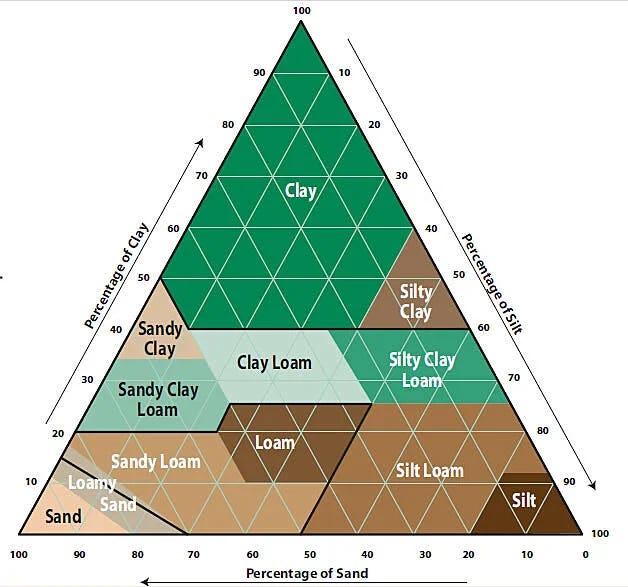
You can take samples and send them off to a university testing lab to get precise results that include pH and soil organic matter as well as the mineral make-up (look up your local Cooperative Extension agency - these soil tests are inexpensive and easy to do, but take a few weeks to get back).
Or you can do quick-and-dirty at-home soil test using the jar method or a ribbon test to find out if your soil is clay-heavy, sandy, or loamy.
Is it disturbed? Many modern yards have stripped topsoil or fill material—this impacts water holding, nutrient availability, and root growth.
Drainage & moisture
Where does water go when it rains? Does it run off quickly or pool and stay soggy?
Do some areas dry out quickly while others hold moisture?
You can dig some test holes with a shovel or trowel that are about a foot deep. Using a bucket or hose, fill the hole with water and let it drain completely. Then fill it again with water and measure the rate at which it drains (see this resource for details). You will then have an idea as to whether your soil is poorly drained (clay or compacted soil), well drained, or extremely well drained (sandy/gravelly).
Tree canopy & root competition
Are there mature trees nearby? Their roots change the soil environment and compete with new plantings for water and nutrients. You still have options; simply observe the existing conditions and let the knowledge aid you in your plant choices.
Soil history
Has your site been developed, filled, compacted, or graded?
Was it once farmland, forest, or wetland? Search for historic aerial photos (your state or county may have an online GIS viewer that lets you see what your spot looked like up to 100 years ago!
Ecological context
Are you near a forest edge, a meadow, or a stream? Does your property abut a park or conservation area?
Think about your garden as an extension of those natural areas—what you plant can help support the larger ecological web.
Climate extremes
Is your site exposed to wind, heat, or cold?
Is it prone to flooding or drought?
Consider selecting plants that can tolerate stress or swings in conditions—especially as climate patterns shift. Pro tip: lists of native rain garden plants can be a great place to start, since rain gardens are designed to go from periodic inundation to stretches of drought.
Existing vegetation
Of course, note what is currently growing in your landscape, especially any native species, and think about what is thriving where, and what struggles.
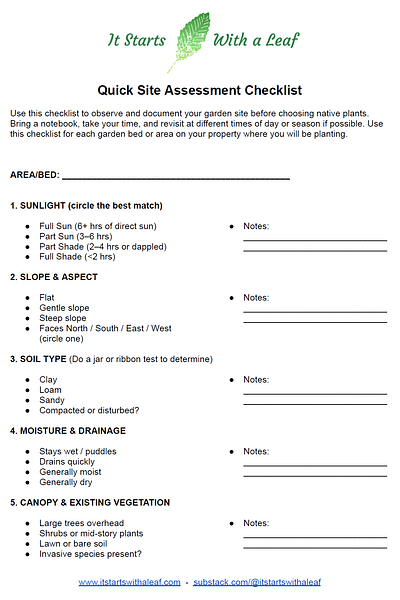
Here is a Quick Site Assessment Checklist you can print or fill out to guide your observations:
Conclusion: What this means for plant choice
Once you’ve gathered your observations, use that info to filter your plant list. Ask yourself:
What kinds of natural plant communities match my site?
What plants are adapted to my site’s light, moisture, soil, and disturbance history?
What’s realistically available at my local native plant nursery?
This is where constraints become your strength: by narrowing your choices, you can focus on combinations that are likely to succeed together—not just survive, but thrive. And they will be tailored to best support the fauna in your area, which is one of the main goals of ecological gardening!
And remember: native plant gardening isn’t about mimicking a wild landscape exactly (that is called ecological restoration)—it’s about working in harmony with your place, for beauty and for biodiversity.
Stay tuned for next week’s post in which I’ll talk about plant compatibility and design considerations!